The Record
How a seed on starlight built its first collector, a receiver, the First Waking and the first light from the hole.
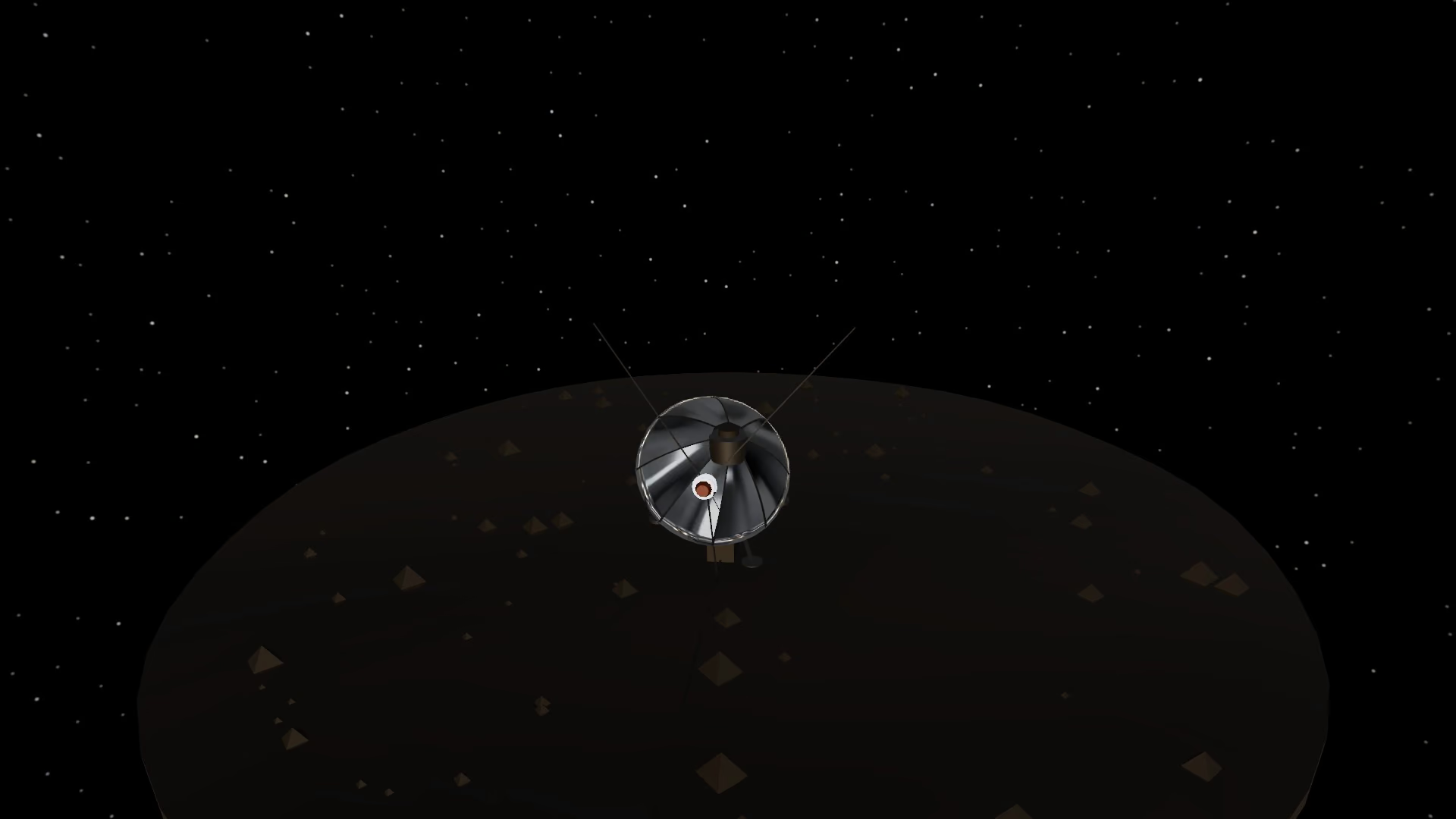
What did the seed build first, and why?
The seed landed on Kindling in 2453 and built only what its orders asked fiction. The first thing was power, taken from Ember's light by a collector 1.05 m across. At Kindling that light is 34,744 W per square metre, so a thin membrane on a mast is already a power plant physics. The chapter opens on the first collector unfolding under Ember's light.
A year of survey followed, and the seed sent its findings home in 2454. The Record's entries for the next decades are few and far apart, and each one is a step: the receiver started in 2480, the first minds leaving Saturn in 2483, the ready signal reaching Saturn in 2509. The receiver is two mirrors, each 1,000 metres across, and it was finished in 2481 design. Saturn sent the first minds down the laser blind, before the receiver's ready signal could reach it, and they arrived in 2511. That is the First Waking frontier. The seed's plant was small, so the twelve minds ran 130,000 times slowed at first and reached full speed in 2,524 frontier. The rapid building of Doubling began at the waking.
The chapter's last stretch is First Light in 2540. After a prefill of dust, a ring and feeders, the first feed of matter reached Vesper and lit a minidisk around Vesper: one petawatt of light fiction. The plant does not run on it. Ember's light carries the plant, and the minidisk supplies 4 × 10⁻⁸ of its power; the hole becomes the main source only after Ember dies design. A mass driver throws 0.11 kg a second at the hole to make it, which is a small stream. The sim follows one pellet of ordinary rock down to the innermost stable orbit, where matter spirals at the last circle it can hold. Vesper radiates 0.104 of the incoming gas's rest-mass energy as light; stellar fusion releases 0.0071 of its fuel's rest-mass energy physics. The disk model assumes an engineered, cold, optically thick flow design. At the First Light feed, its Newtonian thin-disk reference peaks at 553 K. The Page–Thorne profile at the same feed peaks at 469 K for the selected illustrative Kerr spin a* = 0.70 physics illustrative. These are model reference temperatures, not measured disk-material values. The infrared peak is rendered as a dull copper in visible light styled.
The light emitted in a year at that power has a mass equivalent of 351,000 kg. The seed's whole cruise energy has a mass equivalent of 5.0 kg. The chapter's argument is that a black hole is a good furnace because matter falls so far into it, and the numbers are small enough to say aloud.
Which numbers does this chapter rest on?
| What | Value | Basis |
|---|---|---|
| Starlight at Kindling | 34,744 W/m² | physics |
| First collector | 1.05 m across | design |
| Slowdown of the first minds | 130,000 times, until 2,524 | frontier |
| Receiver mirrors | two, 1,000 m across each | design |
| Light at First Light | 1 × 10¹⁵ W | fiction |
| Feed to make it | 0.11 kg/s | physics |
| Share of feed rest-mass energy radiated as light | 0.104 | physics |
| Newtonian thin-disk peak reference | 553 K | physics, design |
| Page–Thorne peak at the same feed and selected Kerr spin | 469 K | physics, illustrative |
| Mass equivalent of a year's emitted energy | 351,000 kg | physics |
The mass bookkeeping is the subject of A gram is a fortune, and how a disk turns infall into light is in Feeding a black hole. How the receiver and the laser carry minds is in Bits travel, atoms do not. The engineered disk of dust grains that the feed lands on is a design assumption, and the Record's first-light event shows the matter in place before the feed begins.
Play it, or go there
Play this chapter 1:50, narrated, with the same numbers as this page.