The Record
What the Record projects for the far end of time: a cold white dwarf, a dark swarm and a black hole warmer than the sky.
What does the Record project for the far future?
Ember is a K dwarf, and the representative track has about 30.3 billion years left at First Light. Its age is not measured: the solar-scaled, nonrotating MIST track selects EEP 326, with mass 0.70 Suns, because its radius and luminosity best match Ember's canonical values design simulation. In the track, the last gigayear is when the Vigil builds a shell of dishes around the minidisk; when Ember leaves the main sequence the shell carries the load simulation. The model follows one MIST age, mass, core, luminosity and radius path through its last first-ascent RGB point. It uses MIST's own mass-loss history for the orbit estimates; tidal drag is omitted, and the chosen age, composition and rotation are not measured frontier. Ember reaches Kindling's widened orbit 2.6 billion years after the main sequence ends, 32.8 billion years after First Light. Kindling supplies the hole and carries the dishes that power upkeep, so the Record's useful work ends at the engulfment. The Record leaves the remaining machinery dark. Ember fills its evolving Roche lobe 29.9 million years later, but transfer stability, accretion power and a replacement plant are not modelled; this later spill does not extend computing frontier. The stellar calculation ends at the RGB point, before it models an AGB or remnant.
The chapter mixes two kinds of uncertainty. The dates come from a model with stated inputs, so they are only as good as those inputs. Some of the physics at the far end, such as how black holes evaporate, is predicted and has not been observed. Ember’s First Light age is a selected track match, not a measured stellar age. The universe keeps cooling. The microwave background falls with the expansion, and in 351 billion years it drops below Vesper's own temperature, 4.3 nK, the faint glow every horizon has simulation. The Record's epilogue ends there, with the machinery dark. The computing ended hundreds of billions of years before, at the engulfment.
Cooling helps computing, because the cost of erasing a bit falls with the temperature of the sky. After the crossover Vesper is the warmest thing there is. Dark energy sets a floor, though: the cold sky stops getting colder at the de Sitter temperature of 2.2 × 10⁻³⁰ K, and no plan to think ever slower on ever less can go below it physics.
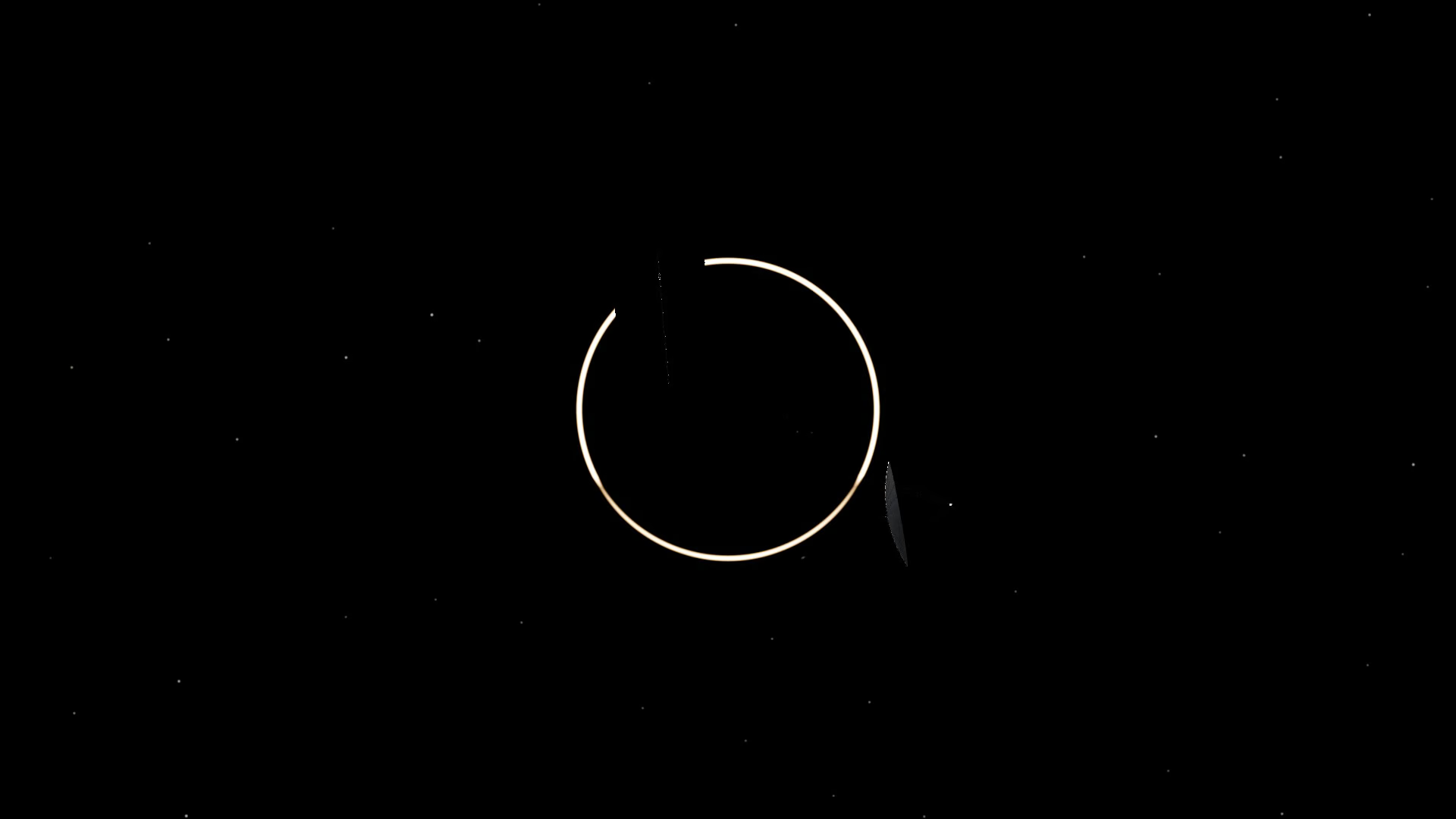
The sim's final frame depicts a cold white dwarf behind Vesper, an authored future beyond the MIST path's RGB endpoint rather than a calculated remnant. All that shows of either is a thin ring of bent pale light with an empty centre, and dark machines drift in front of it with every lamp out. The chapter closes by handing the visitor the probe, the Record and the ledger to explore. Whether a civilization could instead wait out the cooling and think later is a conjecture, the subject of Why they might be asleep, and the model does not assume it frontier.
Which numbers does this chapter rest on?
| What | Value | Basis |
|---|---|---|
| Representative time from First Light to TAMS | 30.3 billion years; Ember's age is unmeasured | simulation; design |
| Kindling engulfed, after First Light | 32.8 billion years | simulation |
| Ember's radius at the tip of its climb | 160 solar radii | simulation |
| Time until the sky is colder than Vesper | 351 billion years | simulation |
| Vesper's Hawking temperature | 4.3 nK | physics |
| The de Sitter floor | 2.2 × 10⁻³⁰ K | physics |
| The universe's age in 2026, for comparison | 13.8 billion years | physics |
The cost of a bit in each era is the toy on Thinking in a cooling universe. Why a black hole glows at all is in Black holes glow, and why the pair of Vesper and Ember never merges is in A pair too wide to hear. The model's own events for this stretch, with their years, are on the chronicle page.
Play it, or go there
Play this chapter 0:55, narrated, with the same numbers as this page.