The Record
The cheapest a bit of memory can be forgotten, and the ladder of scales that leads down to the point where physics stops.
What is the cheapest way to forget a bit?
Computing can be nearly free, and forgetting is not. Every bit that is erased leaves a small, fixed amount of heat set by the temperature of its surroundings physics. At the films' 30 K that cost is 2.9 × 10⁻²² J per bit, so one petawatt of heat can pay for at most 3.5 × 1036 erasures a second. Colder is faster, because a joule buys more bits where the surroundings are cold, which is one reason the Vigil cares how cold its radiators run. The chapter's two toys set the cost of an erased bit against temperature and count the steps of a reversible computation.
Then the sim goes down. It passes a node, a processor slab and a logic die, and each rung is a level of Barrow's scale, which ranks a civilization by the smallest thing it controls design. The levels run from objects through genes, molecules, atoms, nuclei and particles down to space and time. At the gate array the chapter shows the Vigil's main trick. A reversible gate undoes its own work, so nothing is erased and the cost can wait, and each gate spends about 1 × 10⁻²⁰ J challenge. That figure is a switching cost and sits above the 2.9 × 10⁻²² J floor, which applies only to bits that are erased.
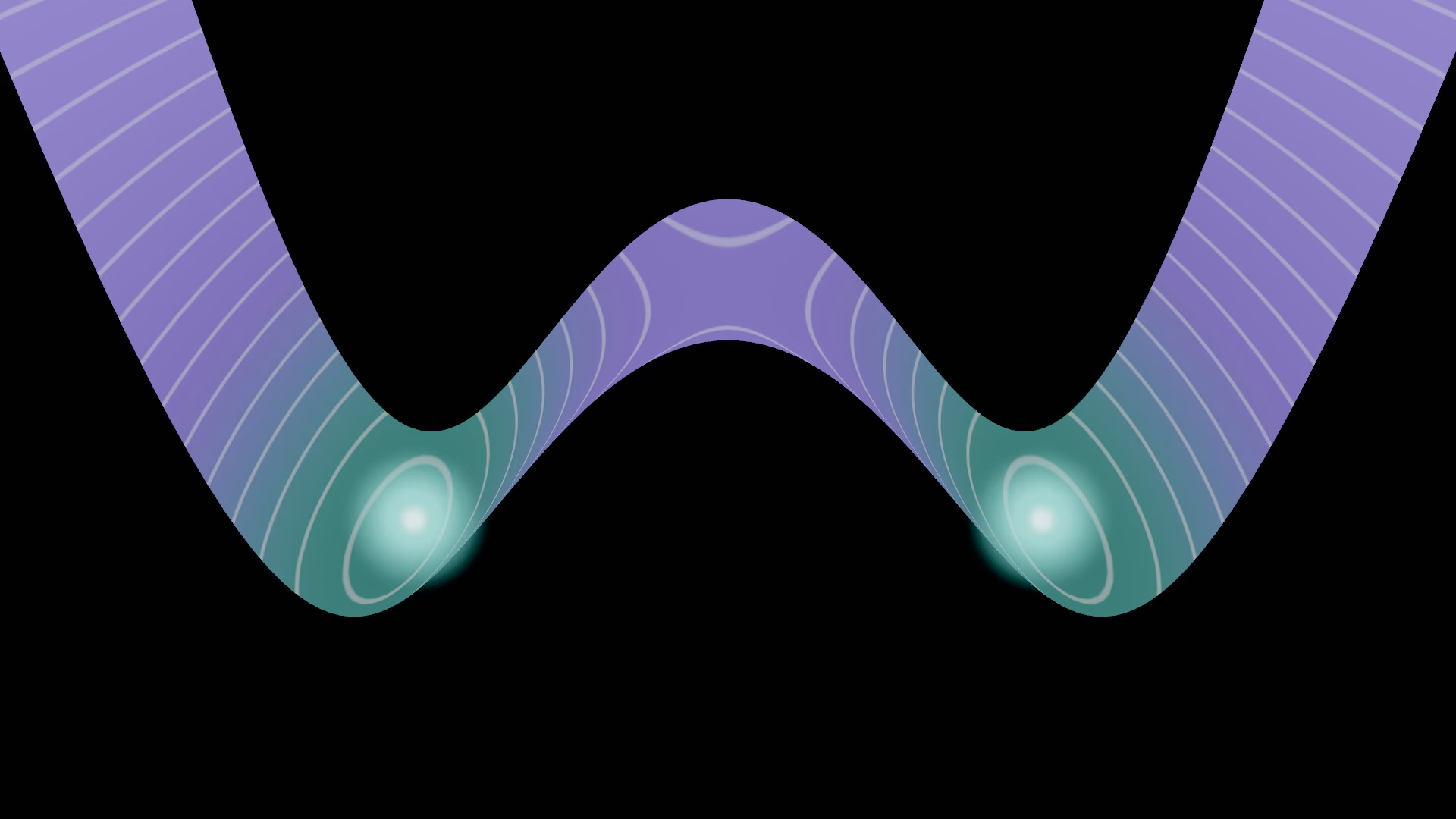
The ladder continues past what engineers can touch. One bit is drawn as a double well: two stable states and a ridge between them. Below that are electrons and atoms, where the chapter gives a speed limit, at most 6.0 × 1033 operations a second for each joule of energy a system has physics. Nuclei hold far more energy per particle, so logic built from them could be far faster. Whether it can be done is unsettled frontier.
The last rung is the Planck length, 1.6 × 10⁻³⁵ m. Known physics stops there and no experiment reaches it, so the chapter marks the end of the map frontier.
Which numbers does this chapter rest on?
| What | Value | Basis |
|---|---|---|
| Film temperature | 30 K | design |
| Cost of one erased bit at that temperature | 2.9 × 10⁻²² J | physics |
| Erasures a second one petawatt can pay for | 3.5 × 1036 | physics |
| A reversible gate's cost | 1 × 10⁻²⁰ J | challenge |
| Speed limit per joule | 6.0 × 1033 operations a second | physics |
| Planck length | 1.6 × 10⁻³⁵ m | frontier |
The erasure cost is derived in The cost of forgetting, and the way around it is in Computing without forgetting. The speed limit is in How fast can anything think?, how much a region can remember is in How much can a region remember?, and the black hole as the limiting case of all three is in The ultimate computer is a black hole. The whole ladder is also on the scale ladder, one rung per power of ten.
Play it, or go there
Play this chapter 2:15, narrated, with the same numbers as this page.