The Record
What it is like, as far as anyone can say, to be a mind that runs on a node in the swarm in 2540.
What is a node, and what runs on it?
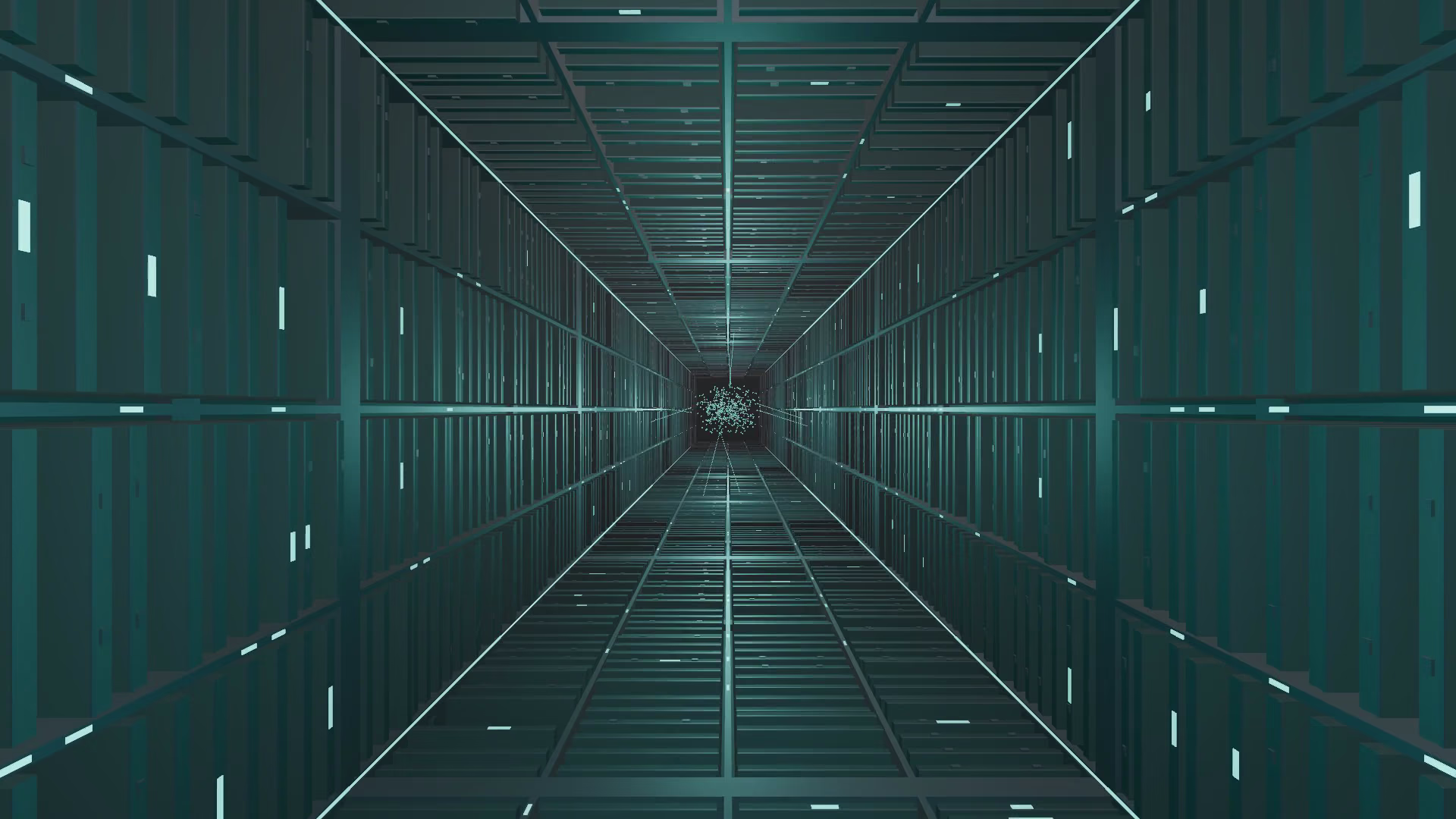
A node is a stack of cold logic joined by optical links, and a mind runs on it as state frontier. The hardware is literal: racks of slabs, memory, links. The Vigil builds four kinds of node, general, reversible, quantum and archive, and the Record lives on the archive nodes fiction. Nothing in it is for a body, and the only light is from status strips. The sim draws a resident as a tableau of light in the aisle, a picture of its state and not of what thinking is like illustrative.
A mind is a pattern of state, so it can be copied. The guide forks itself, lets the copy live for a year and merges it back. The copy returns with about 1.4 × 10⁷ new bits, so only the differences need reconciling frontier. The chapter treats this as a plain engineering fact about software and makes no claim about what it is like to be either copy.
Distance matters more than size. The Vigil's friends are across the swarm, and a reply from the far side of zone C takes 13.3 minutes physics. Residents choose a clock rate and pay for it in energy, and many run slowly on purpose to stay in step with distant friends. The sim's deep zoom measures it from the inside out. The core of one mind that stays in step with a gigahertz clock can be at most 0.30 metres across, because light crosses that in one tick. Its node sits in zone C, whose neighbours are 50 to 200 seconds away from Vesper at light speed. A mind that spans the whole zone ticks once every 6.7 minutes, at 2.5 millihertz physics.
The chapter's argument is that thinking is limited by light. Faster clocks need smaller minds, and bigger minds need slower clocks. The chapter makes no claim about consciousness at any clock rate.
Which numbers does this chapter rest on?
| What | Value | Basis |
|---|---|---|
| New bits a one-year fork brings back | 1.4 × 10⁷ | frontier |
| Round trip across zone C | 13.3 min | physics |
| Size of a mind in step at 1 GHz | 0.30 m | physics |
| Light time from Vesper to zone C | 50 to 200 s | design |
| Crossing zone C | 6.7 min | physics |
| Tick rate across zone C | 2.5 mHz | physics |
Why a mind cannot be both large and fast is worked out in Big minds are slow minds, and the copy, merge and clock questions are in Copy, merge, choose your clock. The nodes include a quantum variant, kept far colder than the films, and What a quantum computer is, and is not says what such a machine can and cannot do.
Play it, or go there
Play this chapter 1:50, narrated, with the same numbers as this page.