The Record
Where the Vigil turns matter into light, and what a near-horizon probe finds at the black hole it feeds.
What does the Engine do, and what does the probe see?
Zone A is where matter goes in. Feeders and collectors hold a stream of matter that falls toward Vesper at 0.11 kg a second, and a minidisk of heated gas turns it into 1 × 10¹⁵ W of light design. In 2540 that is the hole's first petawatt of output, but the near-hole ring catches only a tiny share; Ember supplies almost all of the plant's collected power. The plant's petawatt comes from Ember's light caught by dishes in zone B, and recycling the heat through engines gives 1.56 × 10¹⁵ W of computing physics. The long-range plan expects the hole to replace starlight as Ember evolves. The Record's stellar model ends useful work when Ember engulfs Kindling; it does not model computing beyond that point. The chapter's card says it plainly: starlight is a loan, and the hole is an inheritance.
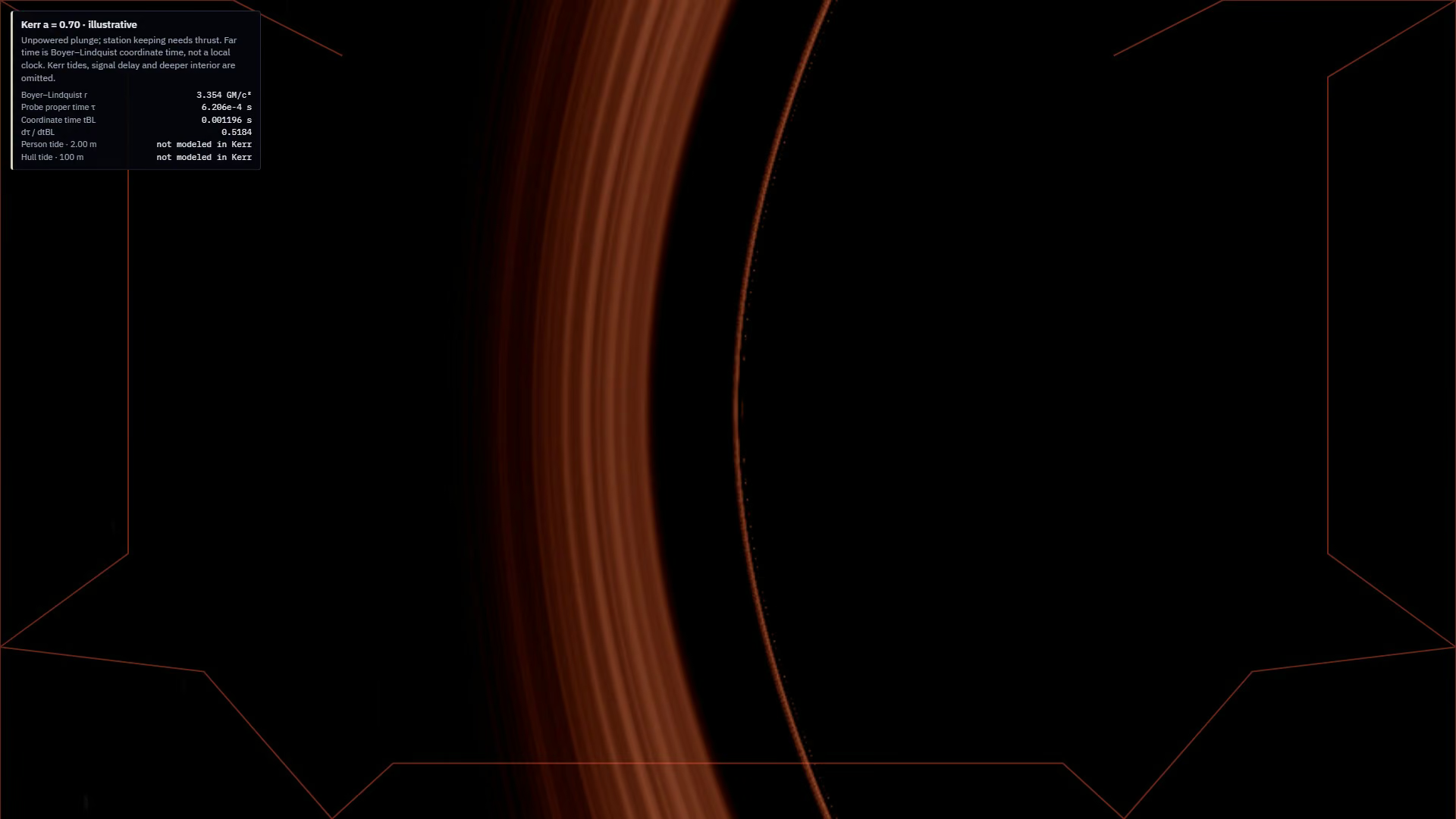
The chapter's dive uses an illustrative Kerr model with dimensionless spin a* = 0.70. Its sampled plunge starts just inside the prograde innermost stable circular orbit, crosses the outer horizon in finite probe proper time and stops at r = 1.00 GM/c², a bounded point halfway between the horizons illustrative. The Kerr HUD compares probe proper time with Boyer–Lindquist coordinate time outside the outer horizon; it does not calculate light-signal arrival times and gives no coordinate-time reading after the crossing. The Kerr dive does not compute a tide limit.
The film's tide reading makes a separate non-spinning Schwarzschild comparison: a clock held at 1.01 Schwarzschild radii runs 10 times slow against a distant clock, and the radial tide across a person's two-metre height at the Schwarzschild horizon is 1.4 × 10⁸ m/s² physics. That reference tide is why the housed probe is designed as a machine.
The next stretch pulls back to show the swarm whole, then Vesper with Ember beyond it, 1.5 AU apart and circling each other every 188 days. It gives the chapter's hardest fact, and its toy lets the visitor test it by aiming heat at the hole. In the non-spinning Hawking reference, Vesper is the coldest thing in reach and still a poor freezer. From a 30 K film it can swallow at most 4.9 × 10⁹ W, which is 5 × 10⁻⁶ of the swarm's heat physics. A black hole is small, and faint heat cannot be squeezed into a small window. The hole cannot take the swarm's heat, so it still has to leave as light from the films, which is the problem the previous chapter set.
The Kerr sequence then continues to the prograde equatorial photon orbit at r = 2.01 GM/c². Kerr has distinct prograde and retrograde equatorial photon orbits; the journey depicts the prograde one. The modeled dive ends at its bounded point before the inner horizon, not at the ring singularity illustrative. The tables keep the non-spinning optical, clock, tide and Hawking-sink references separate from the illustrative Kerr horizon properties.
Which numbers does this chapter rest on?
First Light plant
| What | Value | Basis |
|---|---|---|
| Feed for one petawatt of light | 0.11 kg/s | physics |
| Computing after recycling heat | 1.56 × 10¹⁵ W | physics |
Non-spinning Schwarzschild reference
| What | Value | Basis |
|---|---|---|
| Schwarzschild-reference probe orbit | 4,000 km | design |
| Radial tide across two metres at the Schwarzschild horizon | 1.4 × 10⁸ m/s² | physics |
| Schwarzschild Hawking-sink limit for a 30 K film | 4.9 × 10⁹ W | physics |
| Schwarzschild shadow diameter | 184 km | physics |
| Schwarzschild photon sphere | 53.2 km | physics |
Illustrative Kerr horizon properties
| What | Value | Basis |
|---|---|---|
| Kerr outer horizon radius at the configured spin | 30.4 km | illustrative |
| Kerr horizon entropy estimate at the configured spin | 1.9 × 1079 bits | frontier |
How the Vigil gets more computing from the same heat is in Recycling heat, and why the hole cannot be used as a freezer is in The black hole is not your freezer. The clock and tide numbers are in Clocks near the horizon and Ships die of tides, not of curvature, and the horizon's bit count is the subject of How much can a region remember?.
Play it, or go there
Play this chapter 2:15, narrated, with the same numbers as this page.