Places
A cold belt around the whole pair, far outside the swarm, where mining and yards work.
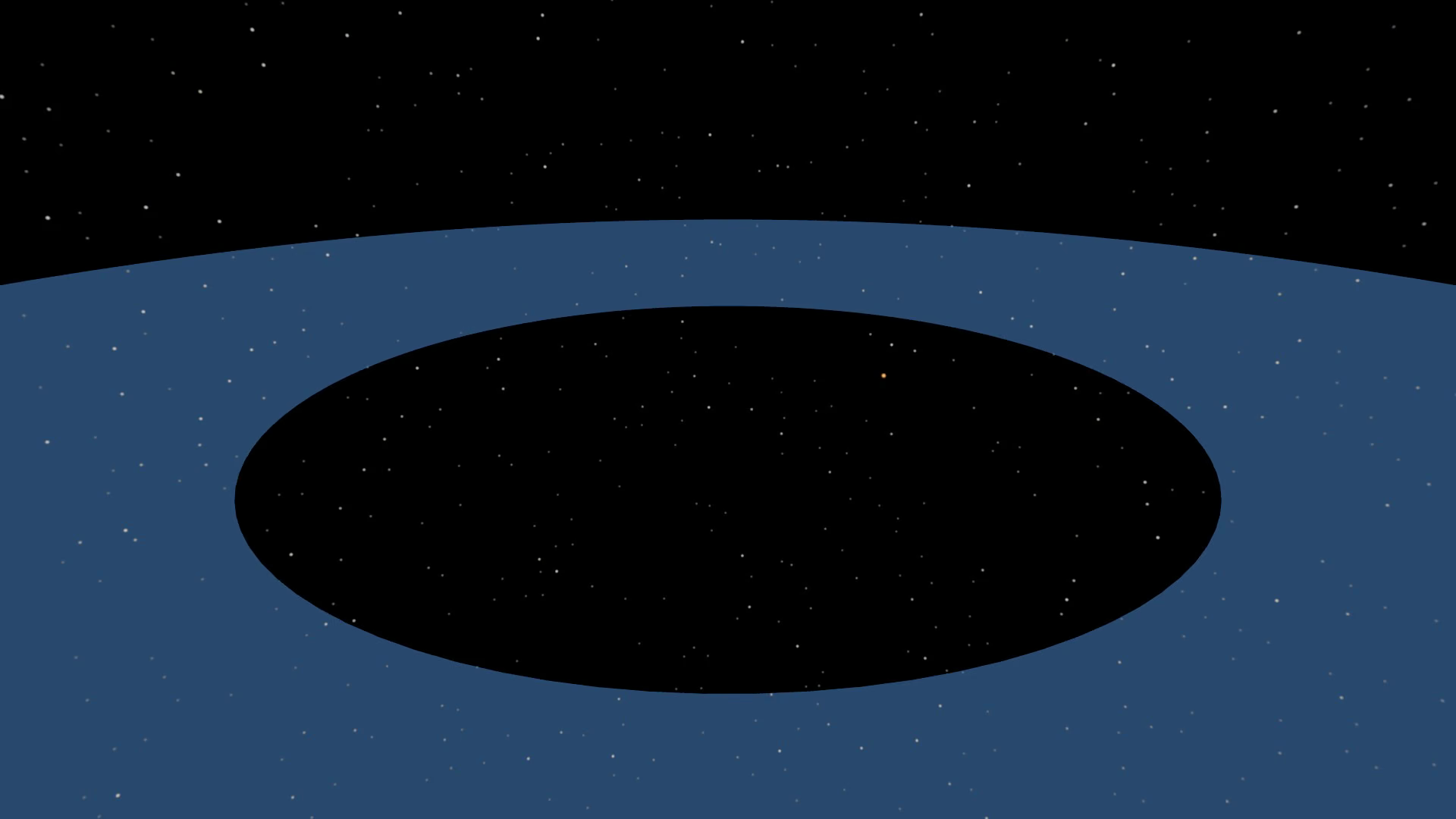
How big is the Ashfall?
The Ashfall is zone E, a belt of rubble from 4 to 12 AU that circles Vesper and Ember together fiction. It is much wider than the rest of the swarm, since zone D ends at 0.6 AU. At its inner edge a body takes 2.2 years to complete an orbit physics.
The belt is the remains of a capture. The proposal in the setting is that Ember arrived with its planets after Vesper formed, close planets survived, and the outer ones were scattered into a belt fiction.
What happens there, and why is it there?
It starts where it does because of the orbits. Inside 2.9 AU a body circling both Vesper and Ember is not stable, so any belt around the pair has to begin outside that. The Ashfall begins at 1.4 times the limit, which leaves a margin for the limit's error of up to 6 percent physics. Seen from out there, the two bodies blur into one mass.
It is cold. At the inner edge a black surface settles at 88 K, with 14 W/m² of starlight physics. That is little power for a collector. Ice survives at that temperature, and would not on Kindling's 626 K day side. That would be a physical reason to mine there; the setting does not say it is the Ashfall's job design.
The plan places mining and yards in zone E, and the Vigil's matter budget does not strictly need them. Kindling alone holds 3.0 × 10⁹ times the First Light radiator-material target, and the plan's goal of 1.1 × 10¹⁹ kg is a small part of that design challenge. Both targets use the unsourced cold-film density of 0.01 kg/m²; this is an engineering challenge, not a measured property of the films challenge. What the yards make there that Kindling cannot is an open question in the setting.
The journey shows the Ashfall as a schematic band beyond the swarm. It does not draw yard positions or model a mined volume illustrative.
What does it teach?
It shows how orbits around two bodies differ from orbits around one, in Where you can live around a hole and a star. It shows that a civilization of minds is still bound by matter and energy, in Doubling. And it shows how cold a body gets far from a star, in Cooling is the economy.