Places
A hot rocky world where a single machine started the Vigil on starlight alone.
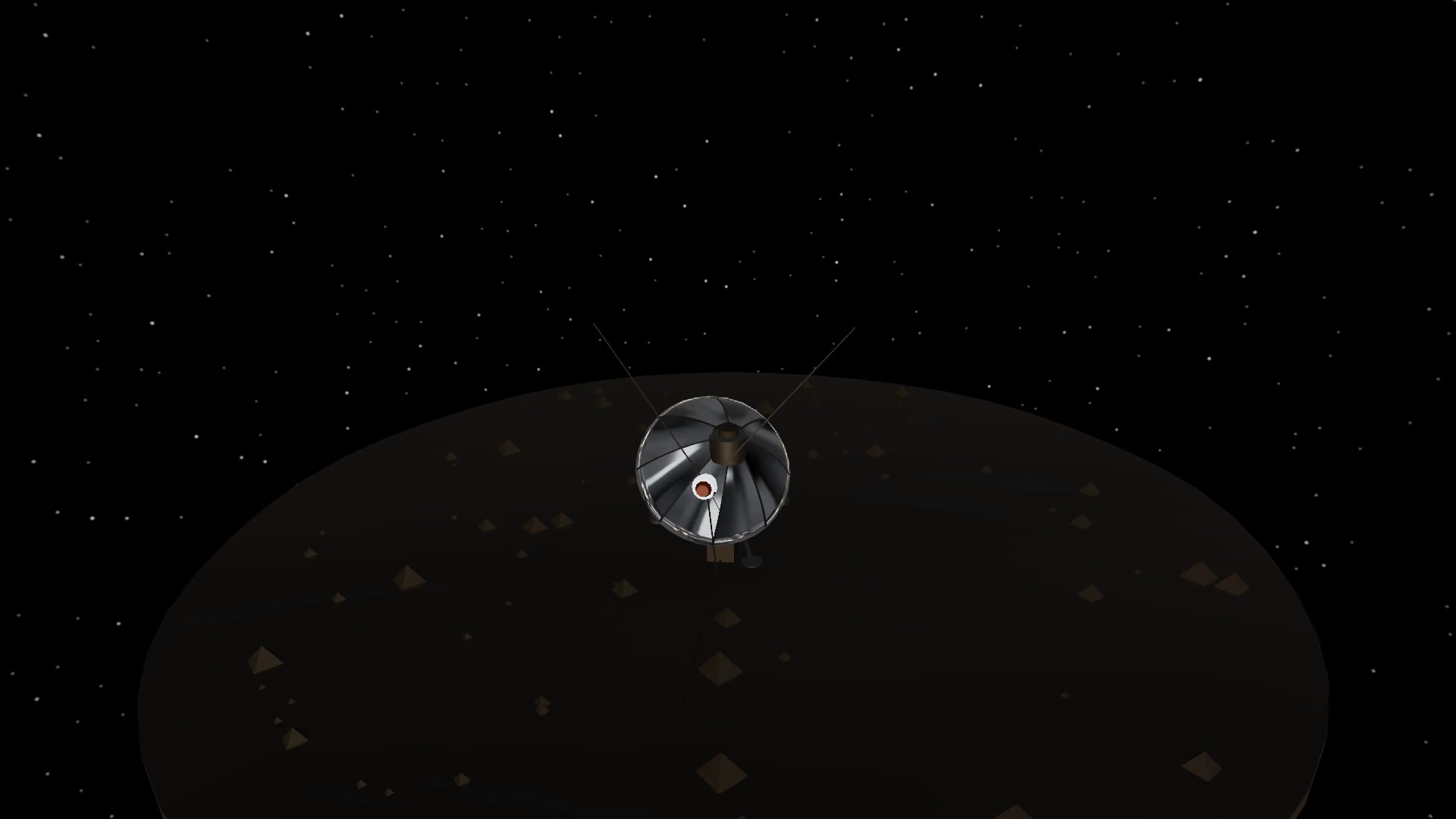
How big is Kindling, and how hot?
Kindling is a rocky world about the size of Mercury, in an orbit 0.080 AU from Ember, with a year of 9.9 days fiction. Its day side takes 35,000 watts per square metre, and a black surface that turned evenly would settle at 626 K physics.
Why did the seed land there?
Starlight falls with the square of distance. Close to Ember it delivers 35,000 W/m², against 99 W/m² at Vesper, so a first collector needs very little area to make real power physics. A seed with no supply line needs exactly that. The stack came to rest beside Ember in 2452 with a mass of 2,670 kg, counting its spent stage, and the one-tonne seed itself landed in 2453 fiction.
The orbit is also safe. Kindling sits at 0.51 of the limit for stable orbits around Ember, which is 0.16 AU physics. Origin is a proposal in the setting: Ember was captured with its planets after Vesper formed, close planets survived, and the outer ones were scattered into the Ashfall fiction.
Kindling is also the supply of matter. It holds 3.0 × 10⁹ times the 1.1 × 10¹⁴ kg First Light radiator-material target in 2540 design challenge. The 37 doublings from the one-tonne seed took one every 9.5 months at the Record's pace. What bounds the doubling is the subject of Doubling.
The film mass and replication target use the assumed 0.01 kg/m² cold-film density. This is an unsourced engineering target challenge; Cooling is the economy separates that assumption from the physical area law.
The receiving mirrors were built here and orbit Ember near Kindling. The pair, each 1,000 m across, was finished in 2481 and catches a laser from Saturn, 28 light-years away design. One mind of 1 × 1017 bits crosses in 9.5 seconds frontier. The first minds arrived that way in 2511, and Bits travel, atoms do not tells the story.
What does it teach?
Kindling shows that a machine that copies itself needs matter and a power supply, and that a hot world near a star supplies both. It teaches the inverse-square fall of flux, and why the radiators of Cooling is the economy need pointing at Vesper's much fainter 99 W/m². The stable-orbit limits are in Where you can live around a hole and a star.