Places
A small orange star that lights the Vigil on loan.
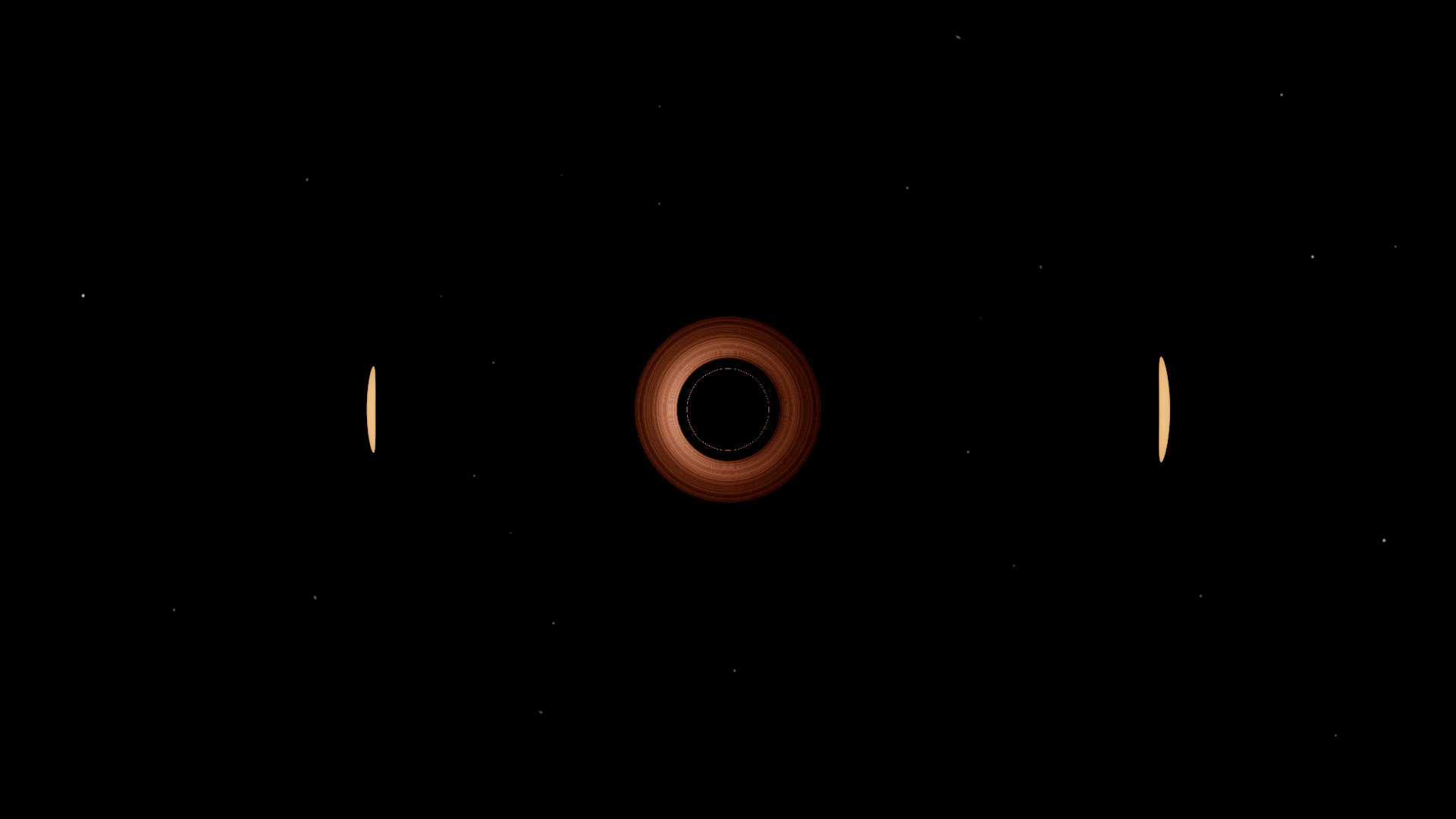
How big is Ember, and how bright?
At First Light, the canonical model gives Ember a K-type dwarf's 0.70 solar masses, 0.68 solar radii, 4,450 K surface and 0.16 of the Sun's luminosity fiction. That is dimmer than the Sun and a deeper orange, because a cooler surface glows redder physics. It circles Vesper at 1.5 AU once every 188 days, at 82 km/s, and the black hole moves at 5 km/s on its own small orbit.
The star's wobble is how the pair is found. From 28 light-years it shifts the star by 165 milliarcseconds each orbit, and a real star, Gaia BH1, was found the same way physics. The wobble is the subject of A pair too wide to hear.
What does it do there, and why is it where it is?
Ember is the main light source in the system. At Vesper's distance its light carries 99 watts through each square metre that faces it, and a film at 30 K emits only 0.046 W/m² physics. Starlight is stronger than the radiator's own glow by a factor of 2,152. The Vigil keeps cool by pointing: a film turned edge-on stays cold until it tilts by 0.46 milliradians, and a tilt beyond that lets in more light than it sheds design.
At First Light Ember cannot feed the hole. The star fills only 1.2 percent of its Roche lobe, so Vesper pulls no gas off it, and the hole stays dark until the Vigil feeds it physics. As a gross energy comparison, feeding the same mass of material to Vesper could release 217 times the starlight Ember emits over the representative track's remaining 30 billion main-sequence years. This comparison does not include the energy or engineering needed to lift material from the star or deliver it to the hole simulation challenge. Starlight is a loan, and the hole is the inheritance.
The representative MIST track also follows Ember as it expands much later. At the modeled Kindling-engulfment event, the Record ends useful work. Whether a later stellar overflow could power computing is not modeled simulation frontier.
At the plan's goal of 1 × 10²⁰ W, the whole swarm would use 1.6 × 10⁻⁶ of Ember's output simulation. Even the plan's goal takes a sliver of the star's output.
What does it teach?
Why a bound pair has safe and unsafe orbits is in Where you can live around a hole and a star. Why a cold radiator near a star must be pointed is in Cooling is the economy. What feeding a star to a black hole is worth is in A gram is a fortune. The closest real match is Gaia BH1, a star circling a dark companion about 186 days.