Places
Matter goes in and light comes out, in a thin disk of dust grains around Vesper.
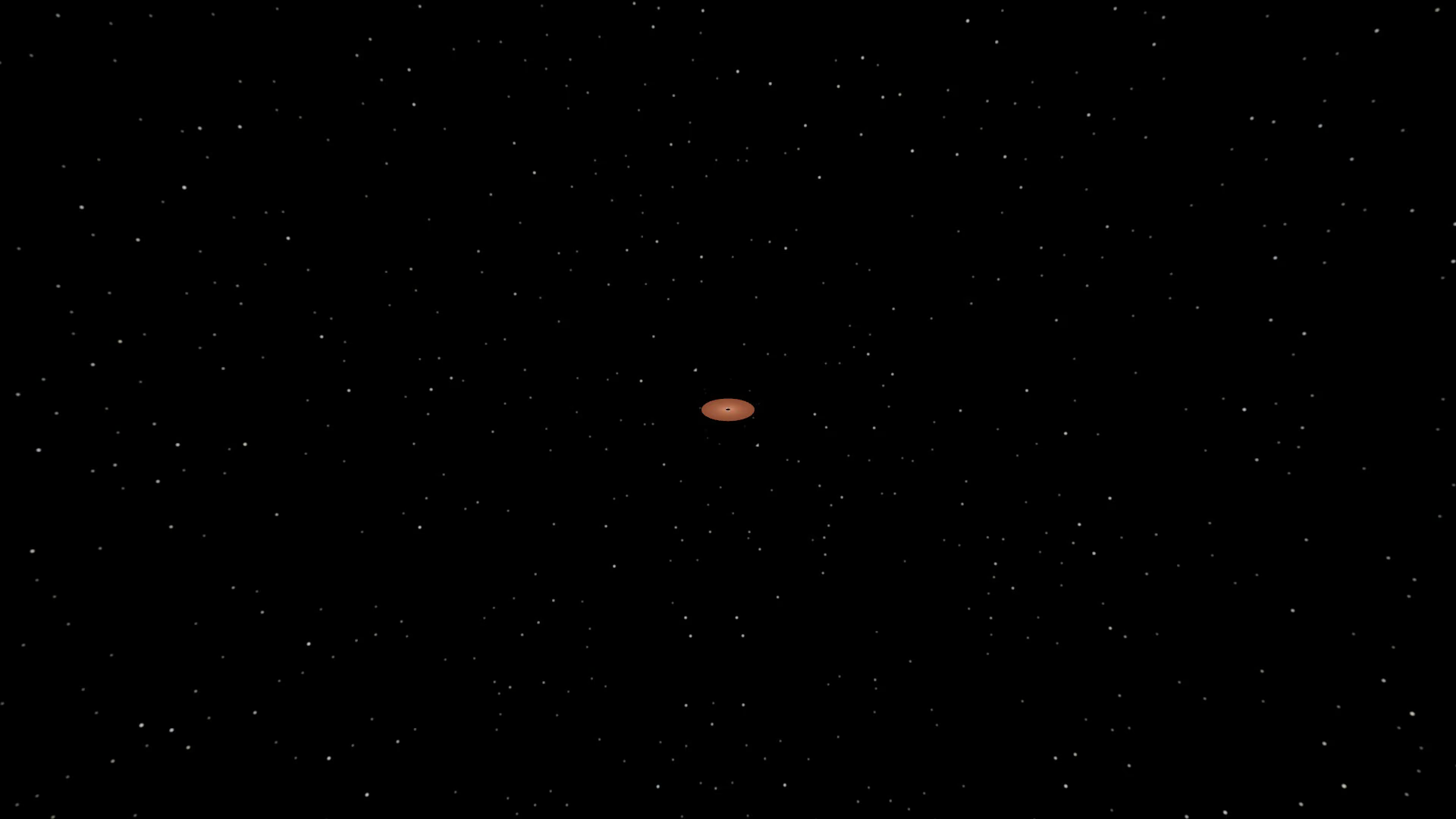
How much goes in, and how big is the disk?
Zone A is the region from Vesper out to 0.05 AU. The disk itself is much smaller. The horizon lies 30.4 km from the centre, and gas can circle as close as 60 km, the innermost stable orbit for Vesper's spin physics. The minidisk begins there.
At First Light in 2540, one petawatt takes 0.11 kg of gas a second physics. That is the feed on a spinning hole, and a non-spinning one would need 0.19 kg a second physics. At the plan's goal of 1 × 10²⁰ W the feed is about 11,000 kg a second simulation.
What happens there, and why is it a disk?
Gas falling toward a hole carries angular momentum, so it cannot drop straight in. It spreads into a flat accretion disk, rings rub against rings, and the friction heats the gas. About 10.4 percent of the incoming gas's rest-mass energy is radiated as light on the way down physics.
The feed arrives as pellet streams from mass drivers, called feeders. A stream of pellets in vacuum is invisible, so nothing glows along its path design.
The disk is cool and has to be built. Gas fed this slowly would fall hot and radiate almost nothing: the fit to hot flows gives 1 × 10⁻¹⁰ of the rest-mass energy, which is 1 × 10⁶ W from First Light's feed, not a petawatt physics. To glow black the disk needs 0.008 kg of dust on each square metre, grains 1 × 10⁻⁶ m across that cool by their own surfaces. That is 2 × 10⁹ kg of dust in orbit before the first watt, the load of 14 feeders for a year, and 573 times the gas a free disk would hold there design. How the dust is made to drift inward at 26 micrometres a second, without the magnetic turbulence cold dust cannot support, is not known frontier. Its Newtonian thin-disk peak at First Light is 553 K, or 5.2 micrometres in the infrared. A human eye would see a dull copper glow challenge. At goal the Newtonian reference peak reaches 9,842 K, in the ultraviolet simulation. Even the plan's goal is only 6.6 × 10⁻¹³ of the Eddington limit, the ceiling set by light pushing back on the gas physics.
Who powers the Vigil?
At First Light the petawatt the nodes run on is Ember's light, not the disk's design. Ember puts out 6 × 10¹⁰ times that power. A 600 m dish in zone B catches 99 W/m² of it and delivers 1.1 × 10⁷ W after conversion, so the petawatt takes 8.9 × 10⁷ dishes, 0.007 of the film's mass. The same dish at zone B's inner edge would catch 0.4 W of the disk's light, because a petawatt spread over a sphere that size is a millionth of a watt on each square metre physics.
The disk's own light is caught by a ring of 1,000 dishes flying 1.6 × 10⁷ m out, as near as a membrane of that size survives the hole's tide. They catch 4 × 10⁻⁸ of the power: the ring is where the engine is measured. A ring dish out-earns a zone B dish only above 3 × 10¹⁷ W. After Ember's light is gone, a shell covering half the ring's sphere must carry the whole plant, and the disk must then radiate 5 times the ledger's light, because dishes cover half the sky and convert 0.4 of what they catch design.
And the Hawking sink?
The Hawking-sink experiment sits at the outer edge of zone A. The ceiling on what the hole can take from 30 K sources is 4.9 × 10⁹ W physics.
Nobody goes near. A mind in a probe may orbit and cannot hover: holding still at 1.01 horizon radii needs 1.2 × 10¹³ m/s² physics.
What does it teach?
The radiated share of 10.4 percent depends on how close gas can orbit, and that depends on spin: Feeding a black hole and Mining a spinning hole. How much of the feed's rest-mass energy becomes light is in A gram is a fortune. Why the black hole cannot also be the heat sink is in The black hole is not your freezer.